
RV Jack Certification Guide: CE, FCC, E-Mark, ISO — What Every Importer Should Know
Understand the certifications required for importing RV jacks and leveling systems — CE, FCC, IC, E-Mark, ISO 9001, and Intertek verification. Learn what each covers, which markets mandate it, and how to verify compliance before placing an order.
RV Jack Certification Guide: CE, FCC, E-Mark, ISO — What Every Importer Should Know
A container of electric leveling systems arriving at Rotterdam without a valid CE Declaration of Conformity does not get waved through customs with a warning. It gets held. The importer pays storage fees while scrambling to obtain documentation that should have been verified before the purchase order was signed. In some cases, the shipment is returned. In others, the products are destroyed.
This is not a rare edge case. It is a predictable outcome when importers treat certifications as optional paperwork rather than market access prerequisites.
For RV jacks and leveling systems specifically — products that combine mechanical structure, electrical drive components, and control electronics — the certification landscape spans several overlapping frameworks: product safety directives, electromagnetic compatibility regulations, vehicle type approval standards, and factory quality management systems. Each framework applies to a different market or product characteristic, and each requires different documentation.
This guide explains what each certification actually means, what it requires, which markets mandate it, and how to verify it properly before placing an order.
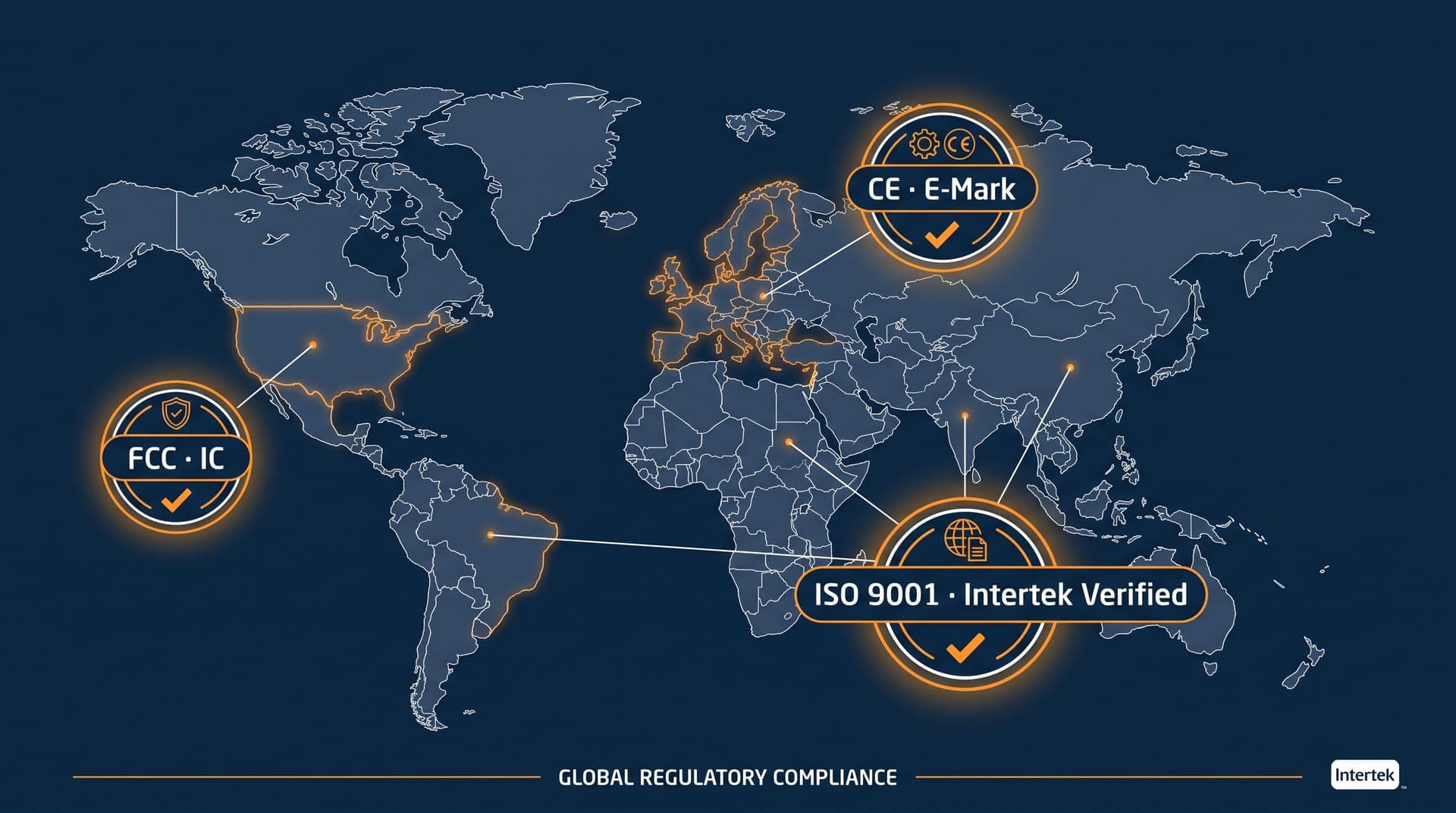
CE Certification (Europe — Mandatory)
CE marking is a legal requirement for placing most electromechanical products on the market in the European Economic Area (EEA). The mark signals that the product conforms to applicable EU directives covering health, safety, and environmental protection. It is not a quality award and not issued by a single testing body — it is the manufacturer's declaration, backed by documented evidence, that the product meets defined requirements.
For RV jacks and leveling systems, two EU directives are typically applicable:
EU Machinery Directive 2006/42/EC governs the mechanical safety of powered machinery, including motorized leveling jacks and lifting systems. It requires a full risk assessment, implementation of risk reduction measures, and preparation of a Technical File documenting the design, hazard analysis, and safety measures. The relevant harmonized standards include EN ISO 12100 (risk assessment methodology) and EN 60204-1 (electrical equipment of machinery).
EMC Directive 2014/30/EU governs electromagnetic compatibility — the ability of the product to operate without generating or being disrupted by electromagnetic interference. This applies to any component with electronic circuitry, including control panels, motor drive units, and remote receivers.
What Importers Should Request
- Declaration of Conformity (DoC) — the legal document signed by the manufacturer affirming conformity
- Technical File index — confirms the file exists and which standards were applied
- Third-party test reports for the harmonized standards listed in the DoC
- Confirm the DoC is specific to the product model you are importing, not a generic template
CE marking applied to a purely mechanical product does not automatically extend to its electrical subcomponents. If the leveling system includes a control panel and motor drive, both mechanical and EMC requirements must be addressed in the same DoC. Verify that both directives are listed.
All Henghong leveling systems and electric jacks carry CE certification covering both the Machinery Directive and EMC Directive requirements. Documentation is available to qualified buyers during the sourcing process.
FCC Certification (USA — Mandatory for Electrical Components)
The Federal Communications Commission (FCC) regulates radio frequency emissions from electronic devices sold in the United States. For RV jacks, FCC compliance falls under Part 15, which covers both intentional emitters (products designed to transmit radio signals, such as wireless remote controls) and unintentional emitters (products that generate RF emissions as a byproduct of operation, such as motor controllers and electronic control boards).
Any leveling system with an electronic control module, motor drive circuitry, or wireless remote is subject to FCC Part 15. This covers the vast majority of powered RV jacks sold in the US market today.
The compliance pathway for most RV jack components is a Supplier's Declaration of Conformity (SDoC), in which the manufacturer self-declares compliance based on testing to FCC Part 15 limits. Products with intentional radio transmitters — wireless remotes operating in unlicensed bands — may require FCC equipment authorization (certification by an accredited test laboratory).
What Importers Should Request
- FCC SDoC signed by the responsible party
- Test report from an accredited laboratory demonstrating compliance with Part 15 radiated and conducted emission limits
- FCC ID number (for intentional radiators) — verifiable through the FCC's public database at fccid.io
- Confirm the test report covers the specific control board revision you are receiving
An Important Note for OEM Buyers
If you are integrating a supplier's leveling system into a vehicle that you manufacture and sell in the US market, FCC compliance responsibility ultimately rests with you as the final equipment manufacturer. The component-level FCC compliance provided by your supplier reduces your risk substantially, but it does not eliminate your obligation to ensure the integrated assembly meets Part 15 requirements in the final vehicle configuration. Verifying FCC compliance at the component sourcing stage is the most effective way to prevent downstream issues during your own regulatory review.
All Henghong electric and electronic products carry FCC certification.
IC Certification (Canada — Required for Electrical Components)
Innovation, Science and Economic Development Canada (ISED), formerly Industry Canada, administers the Canadian equivalent of FCC. Products with electronic control circuitry or wireless communication capability that are sold in Canada must comply with RSS-Gen (General Requirements for Compliance of Radio Apparatus) and the relevant category-specific Radio Standards Specification.
In practice, the technical requirements for IC certification are closely aligned with FCC Part 15, and most suppliers who hold FCC compliance documentation can obtain IC certification without significant additional testing. The two are often processed simultaneously.
IC certification is identified by an IC ID number on the product and in the accompanying documentation. For products with wireless components, the IC ID can be verified through the ISED certification database.
When evaluating a supplier's certification package for the North American market, verify that both FCC and IC are listed — not just one. A product with FCC compliance but no IC certification is not cleared for the Canadian market. Henghong products carry both FCC and IC certification.
E-Mark / ECE R10 (Europe and UNECE Countries — Vehicle-Mounted Components)
E-Mark certification under UNECE Regulation No. 10 (ECE R10) is specifically concerned with electromagnetic compatibility for electronic components that are permanently fitted to vehicles. It is distinct from the CE EMC Directive, though both address electromagnetic compatibility — the difference lies in scope and recognition.
CE EMC applies to products placed on the EU market broadly. E-Mark under ECE R10 applies specifically to components that are type-approved as part of a vehicle, and it is recognized across all UNECE contracting parties — which includes EU member states plus a broader set of countries including the UK, Russia, Japan, South Korea, and others.
For RV leveling systems and electric jacks that are permanently mounted to a vehicle chassis and form part of the vehicle's type-approved configuration, E-Mark compliance under ECE R10 may be required in addition to CE marking. The determination depends on whether the vehicle is subject to type approval in the destination market and whether the leveling system is considered part of the type-approved system.
Practical Guidance for Importers
If your RV product is sold in EU markets through a process that involves vehicle type approval, discuss E-Mark requirements with your compliance team before finalizing the supplier specification. For aftermarket or retrofit leveling systems that are not part of the type-approved vehicle configuration, CE marking is typically the applicable framework.
When in doubt, request clarification from the relevant national type approval authority in your target market, or work with a third-party compliance consultant who specializes in vehicle regulations.
ISO 9001:2015 (Global — Quality Management System)
ISO 9001 is not a product certification. It does not verify that a specific jack or leveling system meets a defined performance standard. What it certifies is that the factory operates a documented Quality Management System (QMS) that meets the requirements of the ISO 9001:2015 standard.
That distinction matters. An ISO 9001 certificate means the factory has defined and documented its processes for design control, production, inspection, non-conformance handling, corrective action, and continuous improvement — and that those processes have been audited by an accredited certification body and found to conform to the standard.
For importers, ISO 9001 certification from a supplier carries two practical implications:
Production consistency. A factory with an active ISO 9001 QMS is more likely to produce consistent product across production runs. The standard requires documented control of production processes, incoming material inspection, and final product verification. This reduces the probability of batch-to-batch variation in the products you receive.
Supplier qualification baseline. Most serious RV OEMs and major importers include ISO 9001 certification as a minimum requirement in their supplier qualification criteria. A supplier without ISO 9001 certification introduces additional due diligence burden because the buyer must independently assess manufacturing capability without the benefit of a third-party audit.
ISO 9001 certificates are issued by accredited certification bodies and carry an expiration date (typically three-year cycles with annual surveillance audits). When verifying a supplier's ISO 9001 status, confirm the certificate is current and that the scope covers the manufacturing operations relevant to your product.
Henghong holds ISO 9001:2015 certification covering its 39,000 m² manufacturing facility in Hangzhou.
Intertek Verification (Supply Chain Due Diligence)
Intertek is an independent testing, inspection, and certification organization. Intertek Verified Supplier status is not a product certification — it is a factory-level credential awarded following a physical on-site audit of the manufacturing facility.
The scope of an Intertek factory audit typically covers:
- Manufacturing capability and production capacity
- Quality control processes and inspection infrastructure
- Product testing and calibration equipment
- Process documentation and traceability systems
- Social compliance and labor practices
The output is a verified supplier profile — a documented record that a trained auditor has physically visited the facility, assessed the operations, and verified the claims the supplier makes about its capabilities.
For importers, particularly those sourcing from overseas for the first time, Intertek verified status provides an independent data point on factory reliability. It is not a substitute for ongoing quality monitoring, but it substantially reduces the risk of onboarding a supplier whose actual manufacturing capability does not match its catalog claims.
Henghong has achieved Intertek Verified Supplier status through on-site factory audit. The verification documentation is available to buyers during qualification.
Which Certifications Do You Actually Need?
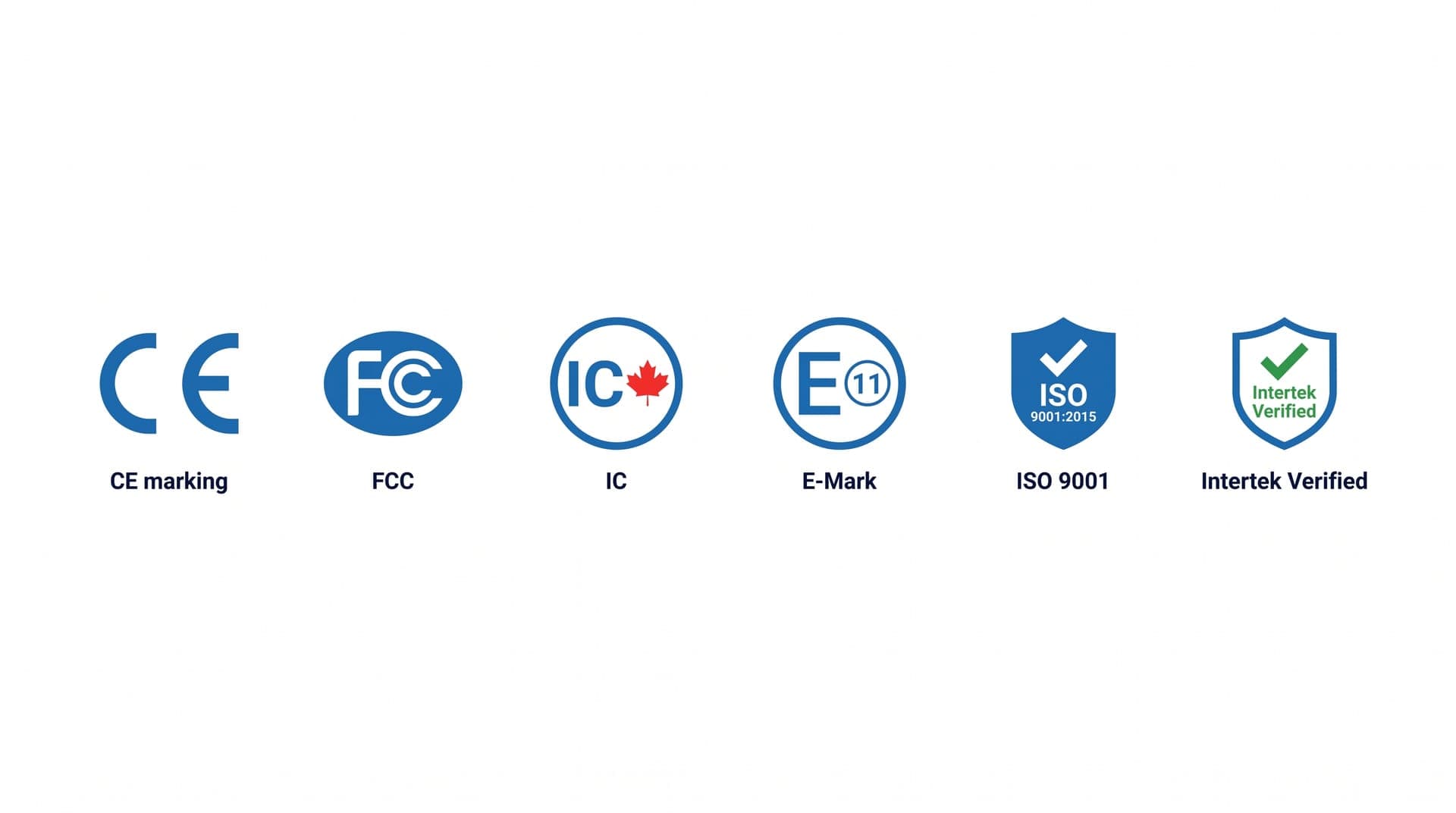
The answer depends on your target market and the specific product category. The table below maps each certification to the markets and product types where it is required or expected.
| Certification | Market | Mandatory? | Covers | RV Jack Relevance |
|---|---|---|---|---|
| CE | European Union / EEA | Yes | Machinery safety, EMC | All motorized jacks and leveling systems sold in EU |
| FCC Part 15 | USA | Yes (with electronics) | Radio frequency emissions | Control panels, remote controls, motor controllers |
| IC / RSS-Gen | Canada | Yes (with electronics) | Radio frequency emissions | Same product categories as FCC |
| E-Mark (ECE R10) | EU + UNECE countries | Yes (vehicle-mounted, type-approved) | EMC for vehicle components | Permanently mounted leveling systems in type-approved vehicles |
| ISO 9001:2015 | Global | No (buyer expectation) | Factory quality management system | Supplier qualification baseline for all markets |
| Intertek Verified | Global | No (buyer preference) | Factory capability audit | New supplier onboarding risk reduction |
A few points worth emphasizing from this table:
CE and FCC/IC are parallel requirements, not alternatives. A leveling system being sold in both the EU and North America needs both CE and FCC/IC. They address different regulatory frameworks in different jurisdictions.
E-Mark operates in parallel with CE in the EU context — the two are not substitutes. A product can carry both CE and E-Mark.
ISO 9001 and Intertek Verified are not product compliance documents. They will not satisfy a customs authority requiring a CE Declaration of Conformity. They belong to the supplier qualification layer of your procurement process, not the product compliance layer.
How to Verify Certifications When Sourcing
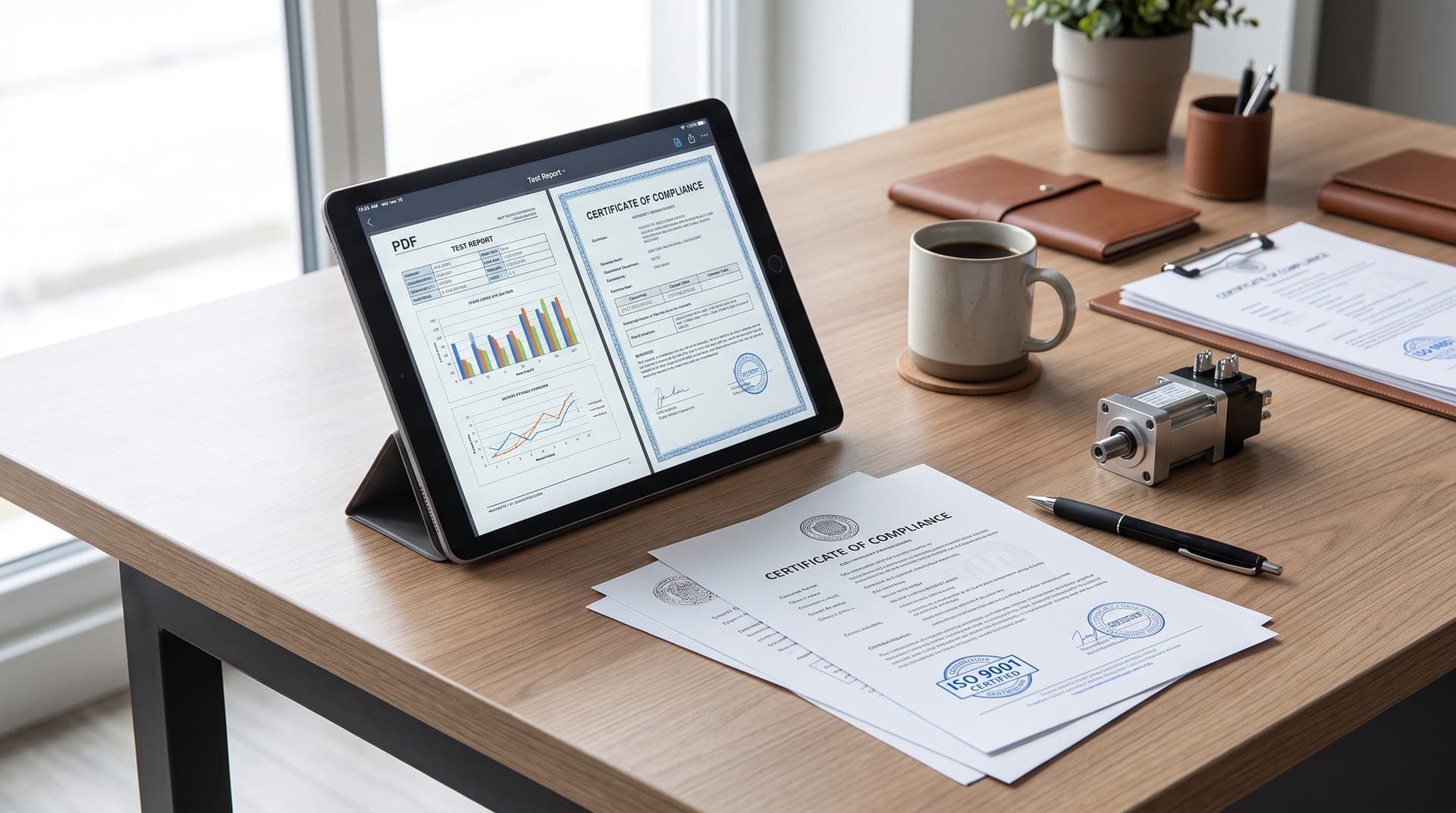
A supplier's website listing certifications is a starting point, not a verification. The following steps confirm that the certifications are real, current, and applicable to the products you are importing.
Request the actual certificate, not a summary. A genuine CE Declaration of Conformity is a specific document, signed by a named responsible party, listing the product model and the directives and standards applied. A table on a website that says "CE Certified" is not documentation.
Check the certificate number against the issuing body's database. ISO 9001 certificates can be verified through the certification body's public registry. FCC ID numbers are searchable at fccid.io. IC IDs are searchable in the ISED database. If a certificate number cannot be verified through an independent source, treat it as unconfirmed.
Verify that the scope covers your specific product. A CE Declaration of Conformity for a hydraulic leveling system does not cover an electric stabilizer jack unless that product is explicitly listed in the document. Confirm that the product model number you are ordering matches the model number on the certificate.
For CE, request the Technical File index. The Technical File is the supporting documentation that backs the DoC — risk assessment, design drawings, test reports, instructions. You do not need the full file for routine sourcing, but requesting the index confirms it exists. A supplier that cannot provide the Technical File index for a CE-marked product is a compliance risk.
For FCC, request the test report. An FCC SDoC is a self-declaration. The test report from an accredited laboratory is the evidence that backs it. The test report should identify the testing laboratory, the specific product tested, the test date, and the pass/fail results against Part 15 limits.
Confirm the certificate holder matches your contracting entity. A CE DoC issued under one factory entity's name does not automatically transfer to a related entity. If the certificate holder and the factory you are contracting with are different legal entities, clarify the relationship and verify that compliance documentation reflects the actual production location.
Henghong makes all certification documentation available to qualified buyers as part of the standard sourcing package.
Common Compliance Mistakes
Assuming CE marking covers all European requirements. CE marking satisfies the EU Machinery Directive and EMC Directive for market placement. It does not automatically satisfy E-Mark requirements for vehicle type approval. If your product is being integrated into a type-approved vehicle for the EU market, verify whether ECE R10 E-Mark is also required.
Treating ISO 9001 as a product certification. ISO 9001 tells you about the factory's quality management processes. It does not tell you that the specific product you are importing has been tested to any product safety standard. Both matter, but they are different documents covering different things.
Not checking that certifications are current. ISO 9001 certificates expire. FCC test reports reference specific hardware revisions. A certificate that was valid three years ago may have lapsed, or the product hardware may have been revised since the test was conducted. Always confirm the issue date and current validity status.
Assuming that a CE-certified mechanical product automatically covers its electrical subassemblies. A mechanical jack body may carry CE marking under the Machinery Directive. If that same product is later fitted with an electric motor and control panel, the electrical assembly introduces EMC Directive requirements that must be separately addressed. This is a common gap when leveling systems are upgraded between model years without updating the compliance documentation.
Failing to account for Canadian requirements separately from US requirements. Importers who distribute in both the US and Canada frequently verify FCC compliance and assume Canada is covered. IC certification is a separate requirement. Products distributed in Canada without IC compliance are non-compliant regardless of FCC status.
Conclusion
CE, FCC, IC, E-Mark, ISO 9001, and Intertek verification each address a different dimension of product or supplier compliance. They are not interchangeable, and they are not all applicable to every market or product type. Understanding which certifications are legally required for your specific market — and how to verify them properly — is a procurement competency that protects your business from customs delays, regulatory penalties, and liability exposure.
The cost of getting this right at the sourcing stage is a few hours of due diligence and a documentation request. The cost of getting it wrong is a held shipment, a product recall, or a field liability claim. The asymmetry is significant.
When evaluating suppliers, treat certification documentation as a hard qualification criterion, not a secondary consideration. A supplier who cannot produce current, verifiable certificates for the markets you are importing into is a compliance liability — regardless of price or lead time.
Need help verifying certifications for your next import?
Contact our compliance team with your target markets and product requirements, and we will provide the relevant documentation package.
Need Help with Your RV Leveling System?
Our engineering team is ready to help you choose the right leveling solution for your vehicle.
Contact Engineering TeamFree OEM Sourcing Checklist
A practical 6-step checklist covering capacity calculation, certification verification, supplier qualification, and logistics planning — designed for RV OEM buyers and procurement teams.
No spam. Your information will not be shared with third parties.