
RV Leveling System Weight Capacity: How to Calculate What You Need
Learn how to calculate the correct RV leveling system weight capacity for your platform. Includes formulas, safety margin guidance, and real examples matched to actual product specifications.
RV Leveling System Weight Capacity: How to Calculate What You Need
When specifying a leveling system for a new RV platform, one of the most consequential decisions an engineering or procurement team makes is capacity. Choose too little, and you risk jack failure, chassis damage, or a warranty incident in the field. Choose too much, and you absorb unnecessary cost, added weight, and integration complexity that your customers will never benefit from.
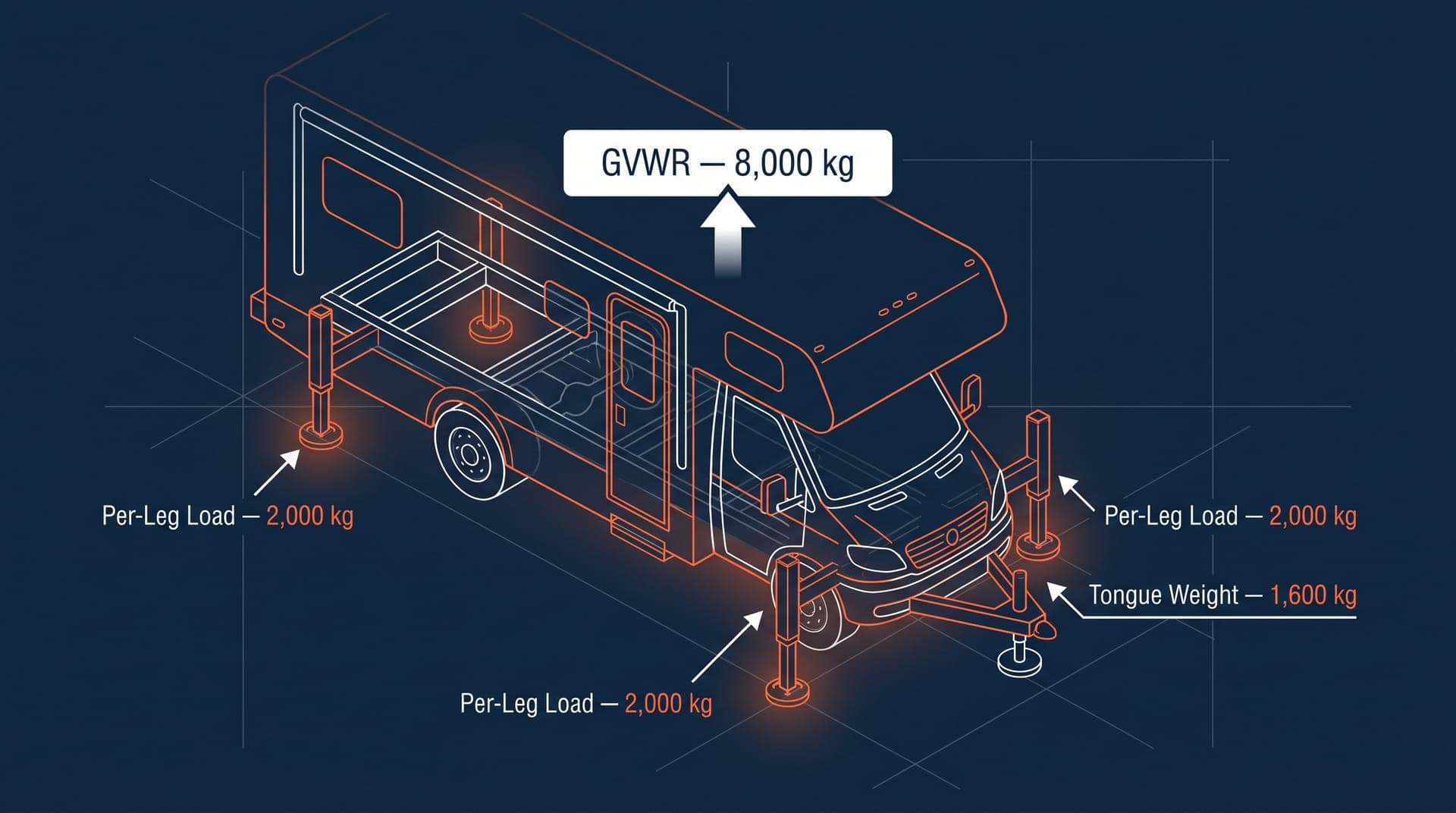
A fully loaded Class A motorhome can exceed 8,000 kg — and if the leveling system is underspecified at that weight, the repair cost can quickly reach five figures. Getting the capacity right from the start prevents field failures, keeps BOM costs under control, and ensures every vehicle performs reliably across the full range of conditions customers encounter.
This guide walks through exactly how to calculate the correct RV leveling system weight capacity for your platform — with real formulas, worked examples, and product references to ground the math in reality.
Why Weight Capacity Matters in RV Leveling Systems
Leveling system failures in the field rarely happen because a manufacturer chose a bad product. They happen because the wrong capacity was specified for the application.
Under-speccing is the more dangerous error. When a leveling system is asked to support more load than it was designed for, the consequences can include cylinder seal failure, jack leg buckling, chassis deformation at mounting points, and in severe cases, vehicle instability during extended parking. These failures are expensive — both in warranty costs and reputational damage with end customers.
Over-speccing carries its own costs. A system rated for twice the actual requirement adds weight to the vehicle, consumes more space for larger cylinders and hydraulic components, draws more current from the vehicle's electrical system, and increases the unit cost of every vehicle produced. For a fleet buyer producing hundreds of units per year, the delta is significant.
Getting the capacity right is an engineering decision that sits at the intersection of safety, cost, and platform longevity.
Understanding Key Weight Terms
Before running any calculation, it helps to have a shared vocabulary. These terms appear in manufacturer datasheets, vehicle specifications, and regulatory documents — and they do not all mean the same thing.
GVWR (Gross Vehicle Weight Rating)
GVWR is the maximum allowable loaded weight of the vehicle, as specified by the chassis or frame manufacturer. It includes the base vehicle weight, all passengers, cargo, water, fuel, and installed equipment. This is your primary input for any leveling system capacity calculation.
Tongue Weight and Pin Weight
For towed units, tongue weight is the downward force the trailer hitch exerts on the tow vehicle. For fifth wheels, the equivalent is pin weight — the vertical load at the kingpin. These figures matter when sizing the front support point of a trailer's leveling system, as that position often bears a disproportionate share of the static load.
For a typical 3,500 kg fifth wheel, pin weight accounts for roughly 20–25% of GVWR — meaning the front legs may see 700–875 kg before any safety factor is applied. Ignoring this concentration can lead to underspecified front jacks even when the overall system capacity appears adequate.
Static Load vs Dynamic Load
This distinction is often misunderstood and has direct consequences for product selection.
Static load is the weight a jack bears when fully extended and holding a stationary vehicle. This is the primary rating for leveling applications.
Dynamic load is the force a jack can exert while actively in motion — during deployment or retraction under load.
Dynamic load ratings are always lower than static ratings. As an example, the HH-400 Electric Stabilizer carries a static capacity of 1,000 kg but a dynamic capacity of 540 kg. Specifying a system based only on static ratings without understanding the dynamic requirement during deployment can lead to motor overload or premature actuator wear.
System Capacity vs Per-Leg Capacity
This is where many procurement decisions go wrong. A "6-ton system" does not mean each leg supports 6 tons. It means the combined system capacity — distributed across all support points — totals 6 tons.
For a 4-leg configuration, a 6-ton system delivers 1,500 kg of capacity per leg under ideal load distribution. Real-world conditions are rarely ideal, which is exactly why safety factors exist.
A Simple Formula for Calculating Capacity Requirements
The calculation itself is straightforward. What matters is applying it consistently and using the right inputs.
Core Formula:
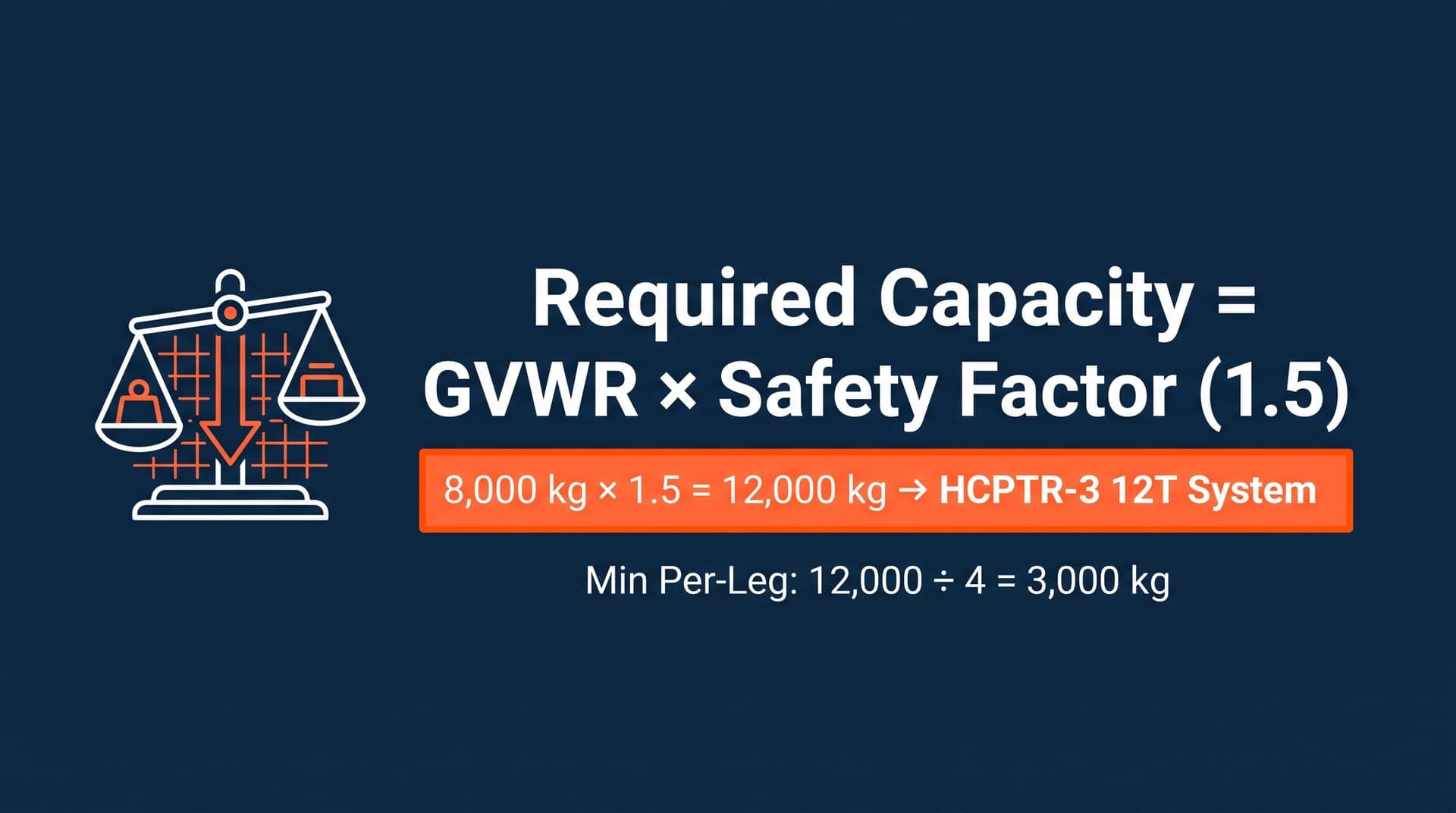
Required System Capacity = GVWR × Safety Factor (1.5 recommended)
Minimum Per-Leg Capacity = Required System Capacity ÷ Number of Support Points
Example 1 — Class A Motorhome
GVWR: 8,000 kg
Safety factor: 1.5
Required system capacity: 8,000 × 1.5 = 12,000 kg
Support points: 4 legs
Minimum per-leg capacity: 12,000 ÷ 4 = 3,000 kg per leg
Recommended system: HCPTR-3 12T — 12,000 kg system capacity, 3,000 kg per-leg capacity, 450mm stroke, DC12V. The 450mm stroke is particularly relevant for Class A platforms where chassis clearance to ground level requires extended travel.
Example 2 — Mid-Size Fifth Wheel or Travel Trailer
GVWR: 3,500 kg
Safety factor: 1.5
Required system capacity: 3,500 × 1.5 = 5,250 kg
Support points: 4 legs
Minimum per-leg capacity: 5,250 ÷ 4 = 1,312 kg per leg
Recommended system: HCPTR-3 6T — 6,000 kg system capacity, 1,500 kg per-leg capacity, DC12V, with monoblock valve technology for synchronized leveling. The 6T system comfortably exceeds the 5,250 kg requirement and provides headroom for asymmetric loading.
Example 3 — Lightweight Trailer
GVWR: 1,500 kg
Safety factor: 1.5
Required system capacity: 1,500 × 1.5 = 2,250 kg
At this weight class, a full hydraulic leveling system is typically over-engineered for the application. The HH-2000 Electric-Hydraulic System (4,000 kg system capacity) covers this range with appropriate flexibility — or for pure stabilization without primary lifting, the HH-400 Electric Stabilizer (1,000 kg static capacity per unit) can serve as a cost-effective auxiliary support solution on each corner.
The 25% Safety Margin Rule — and Why We Recommend 50%
The industry-standard minimum safety factor for leveling system sizing is 1.25, meaning the system should be rated for at least 25% more than the vehicle's GVWR. This figure appears in many general equipment sizing guidelines and is technically defensible under controlled conditions.
For OEM procurement, we recommend a 1.5 safety factor (50% margin) for the following reasons:
Uneven terrain concentrates load. When a vehicle is parked on a slope or irregular surface, the geometry of weight distribution shifts significantly. One or two legs may bear considerably more than their calculated share — sometimes 30–40% above the theoretical even distribution.
Slide-outs create asymmetric loading. A fully extended slide-out on a Class A motorhome can shift the center of gravity by several hundred kilograms toward one side of the vehicle. The leveling system on that side must compensate without being pushed to its design limit.
Wind and vibration during extended parking. An RV parked for days or weeks at a campsite experiences continuous low-level dynamic loading from wind, occupant movement, and ground settlement. These cumulative micro-loads accelerate wear on systems operating near their rated ceiling.
Future equipment additions. OEM production lines evolve. A platform that ships at 7,200 kg GVWR today may be upgraded with additional factory-installed options in the next model year, pushing the actual laden weight closer to the rated GVWR ceiling.
The cost difference between a 1.25 and 1.5 safety factor in system selection is typically marginal. The consequences of a field failure are not.
Different Systems, Different Capacity Ratings
Not all leveling systems are designed for the same role. Understanding the functional category of each system type prevents misapplication before the specification stage.
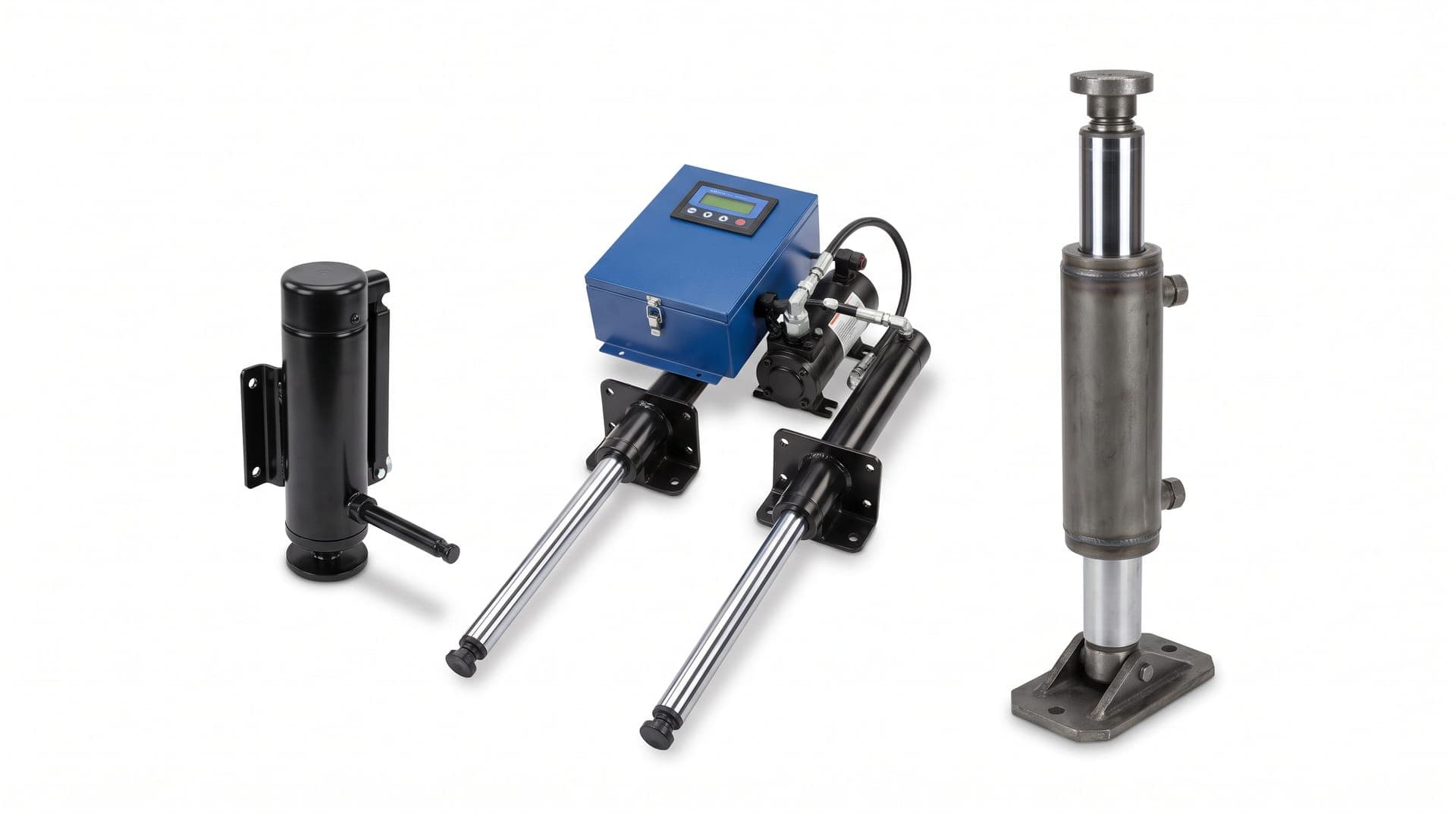
| System Type | Product Example | Capacity Characteristics | Best For |
|---|---|---|---|
| Electric Stabilizer | HH-400 | Static: 1,000 kg / Dynamic: 540 kg per unit | Auxiliary stabilization on travel trailers; secondary support, not primary lifting |
| Electric-Hydraulic | HH-2000 | System: 4,000 kg / Per-leg static: 1–10T configurable | Mid-size RVs, fifth wheels, platforms requiring flexible capacity range |
| Hydraulic (Mid) | HCPTR-3 6T | System: 6,000 kg / Per-leg: 1,500 kg / Stroke: 90–180mm | Fifth wheels, mid-size motorhomes, travel trailers with primary lifting needs |
| Hydraulic (Heavy) | HCPTR-3 12T | System: 12,000 kg / Per-leg: 3,000 kg / Stroke: 450mm | Class A motorhomes, commercial specialty vehicles, heavy transport platforms |
A few notes on reading this table for procurement purposes:
The HH-400 is classified as a stabilizer, not a leveling jack. It is not designed to lift a vehicle off its suspension — it is designed to reduce sway and movement once a vehicle is already parked.
The HCPTR-3 6T and 12T systems both use monoblock valve technology, which synchronizes leg deployment and retraction. This is relevant for OEM integration because it simplifies the hydraulic control architecture and reduces the number of independent valve components to service in the field.
The HH-2000's configurable per-leg range (1–10T) and dual-voltage support (12V/24V) make it a flexible platform for manufacturers developing multiple RV lines at different weight classes.
Beyond Weight — Other Factors That Affect Your Choice
Capacity is the primary filter, but it is not the only one. Once you have identified the systems that meet your weight requirement, the following factors should determine the final selection.
Vehicle type and load geometry. A travel trailer with a rear-heavy load profile has different front-to-rear distribution than a motorhome with a front engine. The physical placement of jacks — and whether the system allows individual leg control — affects how well the system compensates for that distribution.
Chassis mounting space. Larger capacity systems require larger cylinders. The HCPTR-3 12T's 450mm stroke requires more underframe clearance than the 90–180mm range of the 6T. Confirm available mounting depth and outboard clearance before finalizing the specification.
Voltage requirements. Both 12V and 24V configurations are available across the Henghong product line. Heavier commercial platforms typically run 24V electrical systems, which reduces current draw and allows more efficient operation of high-capacity hydraulic pumps. Confirm the vehicle's house battery system voltage before specifying the pump unit.
Stroke length requirements. Stroke determines how much height variation the system can accommodate — both in leveling gradient and in chassis-to-ground clearance. Under-specifying stroke on a tall chassis means the system cannot fully level the vehicle on moderately uneven ground.
Environmental and corrosion resistance. RVs deployed in coastal, high-humidity, or winter road-salt environments place demands on surface finishes, seal materials, and fastener specifications that go beyond the base capacity rating. This is worth discussing directly with the engineering team when specifying for export markets or regional climates.
Common Mistakes OEM Buyers Make
After working with manufacturers across 40+ export markets, a few specification errors appear consistently.
Using curb weight instead of GVWR as the base figure. Curb weight is the weight of an empty, unloaded vehicle. GVWR reflects the maximum real-world operating weight. A system sized against curb weight will be under-specified for every vehicle that leaves the production line with full water tanks, cargo, and occupants — which is every vehicle in service.
Confusing system capacity with per-leg capacity. A buyer who reads "6T system" and assumes each jack handles 6 tons will over-order a smaller system for a heavier vehicle. Always confirm both figures before proceeding.
Ignoring dynamic load during deployment. Ordering a system sized only for static holding capacity, then deploying it fully loaded without accounting for the lower dynamic rating, can trip thermal overloads or damage actuators during field operation — even if the system technically holds the load afterward.
Specifying stroke length from a previous platform without rechecking chassis geometry. When platform architecture changes between model years — frame height, suspension travel, or jack mounting position — a previously adequate stroke length may no longer reach ground contact, or may bottom out before the vehicle is level.
Conclusion
Calculating the correct RV leveling system weight capacity is not complicated, but it requires discipline in using the right inputs and applying an appropriate safety margin. Start with verified GVWR, multiply by a 1.5 safety factor, divide by the number of support points, and confirm that the system you select meets or exceeds that per-leg figure.
From there, validate against stroke length, voltage, mounting geometry, and operating environment. The capacity calculation tells you the minimum — the other factors tell you which product on that shortlist is actually right for your platform.
Done correctly, the specification process prevents field failures, controls BOM cost, and produces a vehicle that performs reliably across the full range of conditions your customers will encounter.
Ready to secure your next leveling system specification?
Not sure which system fits your RV platform? Send us your vehicle specs — GVWR, number of support points, stroke requirement, and voltage — and our engineering team will recommend the right solution within 24 hours.
Need Help with Your RV Leveling System?
Our engineering team is ready to help you choose the right leveling solution for your vehicle.
Contact Engineering TeamFree OEM Sourcing Checklist
A practical 6-step checklist covering capacity calculation, certification verification, supplier qualification, and logistics planning — designed for RV OEM buyers and procurement teams.
No spam. Your information will not be shared with third parties.