
Stabilizer Jacks vs Automatic Leveling Systems: What OEM Buyers Need to Know
Learn the functional differences between RV stabilizer jacks and automatic leveling systems. Understand when each is the right specification — and when a hybrid approach combining both is the best engineering solution.
Stabilizer Jacks vs Automatic Leveling Systems: What OEM Buyers Need to Know
When specifying support systems for a new RV platform, one of the most common points of confusion in the procurement process is also one of the most consequential: the difference between stabilizer jacks and automatic leveling systems. They look similar in product catalogs. They both live under the chassis. But they do fundamentally different jobs — and specifying one where the other is needed creates problems that surface in the field, not on the production floor.
This article explains what each system does, when each is the right choice, and how OEM buyers can make a technically grounded decision before the specification is locked.
Why the Distinction Matters
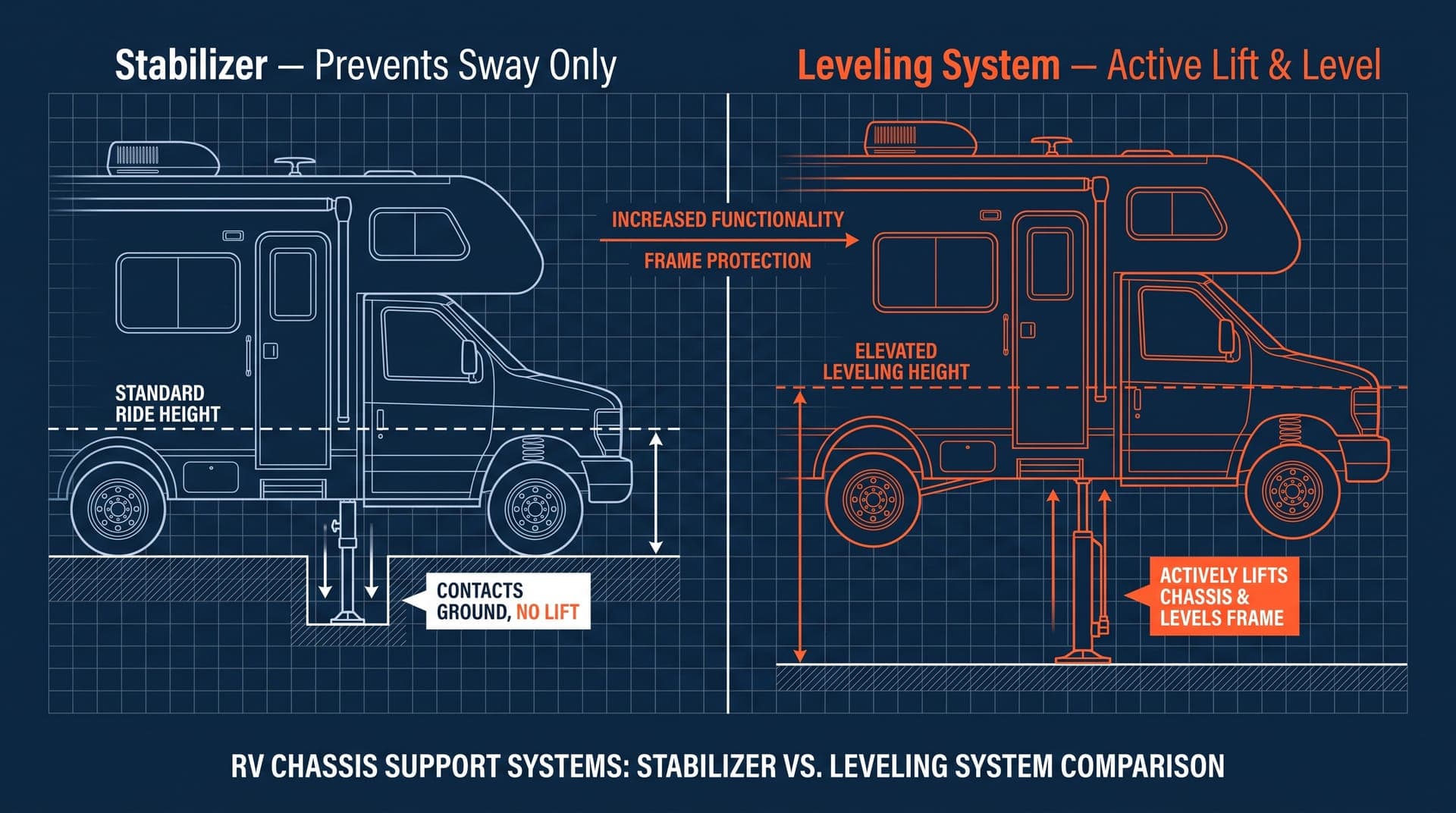
Think of stabilizer jacks as the kickstand on a bicycle. A kickstand keeps the bike from tipping when it is parked, but it does not lift the bike off the ground or correct for an uneven surface. A stabilizer does the same for an RV — it keeps the chassis from rocking when occupants move inside, but it does not actively lift or level the vehicle.
Automatic leveling systems are closer to a car jack. They actively raise the vehicle, work against suspension travel, and can compensate for slope and uneven terrain until the chassis is geometrically level.
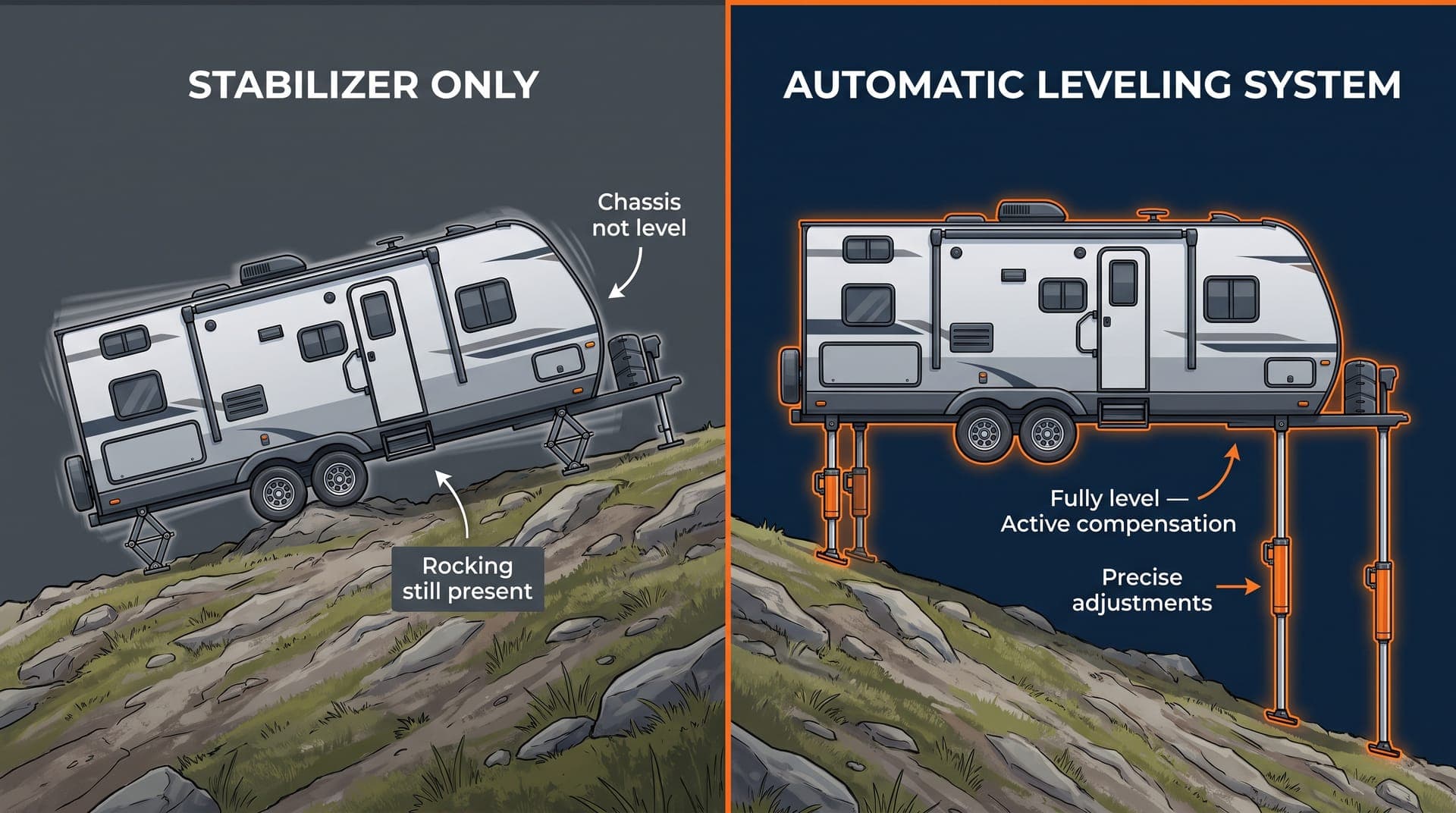
Specifying the wrong system produces predictable failures. Fit stabilizers where a leveling system is required, and end customers will report chassis rocking, slide-out movement, and difficulty with interior stability on anything other than a flat paved site. Spec a full automatic leveling system on a platform where a pair of electric stabilizers would have achieved the same functional result, and the engineering team absorbs the cost, weight, and integration complexity of a system the application did not need.
Both errors are avoidable. They almost always trace back to a specification made without a clear distinction between the two functional categories.
What Is a Stabilizer Jack?
A stabilizer jack is a support device designed to reduce chassis movement, vibration, and sway once the vehicle is already parked and has settled on its suspension. The operative word is "reduce." A stabilizer contacts the ground and limits the range of chassis motion — it does not lift the vehicle or take weight off the suspension in any significant way.
This distinction has a direct consequence for capacity ratings. Because stabilizers are not lifting, their rated load is a holding resistance against lateral and vertical movement, not a vertical lifting force. That is why static capacity and dynamic capacity diverge significantly on stabilizer products: the static figure reflects how much downward load the unit can resist while stationary; the dynamic figure reflects how much force it can handle while in motion during deployment or retraction.
Stabilizers are typically lighter, simpler to install, and lower in unit cost than leveling systems. Installation is generally a bolt-on operation at standard chassis mounting points, without the hydraulic plumbing or multi-channel control wiring that a full leveling system requires.
They come in two primary forms for RV applications:
Electric stabilizers: Motor-driven screw actuators that extend and retract at the touch of a button. Common on mid-range and premium travel trailers as factory equipment. The HH-400 Electric Stabilizer is an example — 1,000 kg static capacity, 504mm stroke, DC12V.
Manual scissor jacks: Mechanically operated, positioned by hand and wound down to contact the ground. Common on entry-level trailers and as a cost-effective auxiliary support option. The SC-Series covers a 1,134–3,402 kg range with 610–762mm extended height.
What Is an Automatic Leveling System?
An automatic leveling system is a powered mechanism that actively lifts and repositions the vehicle chassis to achieve a level orientation — regardless of how uneven the parking surface is. It does not merely stabilize a vehicle that is already parked level; it corrects for slope and terrain variation by extending individual legs until tilt sensors confirm that the chassis has reached a defined level threshold.
This active lifting function is what separates leveling systems from stabilizers at a fundamental engineering level. The system must work against the vehicle's suspension — compressing it or lifting it off its travel limit — which requires substantially higher force than simply bracing a chassis against movement. System capacities for hydraulic leveling systems commonly range from 6,000 kg to 12,000 kg or higher.
Control architecture is also meaningfully more complex. An automatic leveling system integrates tilt sensors (typically a two-axis inclinometer), a microprocessor or control module, a hydraulic pump or electrical drive unit, and individual valve or motor control for each leg. A one-touch control sequence reads sensor data, determines which legs require extension, drives each leg until level is achieved, and locks the system in position. Some systems include automatic retract-before-drive interlocks to prevent road departure with jacks extended.
From an OEM integration standpoint, an automatic leveling system is a subsystem in its own right — it requires hydraulic routing or power wiring to each corner of the chassis, a control panel interface, and a calibration step during vehicle commissioning.
Key Differences at a Glance
| Factor | Stabilizer Jack | Automatic Leveling System |
|---|---|---|
| Primary Function | Reduce sway and vibration | Actively lift and level chassis |
| Lifts Vehicle? | No — contact support only | Yes — lifts off suspension |
| Typical Capacity | 500–1,000 kg static hold per unit | 1,500–12,000+ kg system capacity |
| Control | Manual or simple ON/OFF | Microprocessor with tilt sensors |
| Cost per Vehicle | Low | Moderate to high |
| Installation Complexity | Simple bolt-on | Hydraulic/electrical integration required |
| Sensor Integration | Not required | Inclinometer / tilt sensor required |
| Best For | Travel trailers, light-duty platforms | Motorhomes, fifth wheels, heavy trailers |
When to Choose Stabilizer Jacks
Stabilizers are the correct engineering choice in a defined set of scenarios. The decision is not about cutting corners — it is about matching the support function to what the platform actually requires.
Light to medium travel trailers with GVWR under approximately 3,000 kg. At this weight class and typical platform geometry, the primary end-customer complaint is chassis rock and bounce during occupation. A set of rear electric stabilizers and front tongue support addresses this directly, without the system cost or integration complexity of a full leveling system.
Platforms where leveling is achieved through another means. Many travel trailers rely on wheel chocks, leveling blocks, or a manual tongue jack for gross leveling at the hitch, with stabilizers handling residual sway. If the platform architecture already accommodates this approach and the market segment accepts it, adding a powered leveling system adds cost without changing the end-user workflow.
Cost-sensitive OEM lines with defined price positioning. Entry-level and mid-range travel trailer lines operate within tight BOM constraints. Specifying stabilizers over a leveling system at this tier is a deliberate engineering decision, not a deficiency — provided the stabilizer capacity is correctly matched to the platform.
Auxiliary support alongside a primary leveling system. This is discussed in more detail below, but stabilizers are routinely used as secondary support points on larger platforms that already have a leveling system installed. In this configuration, the leveling system handles active positioning, and stabilizers provide additional rigidity at intermediate chassis locations.
When to Choose an Automatic Leveling System
The case for a leveling system is defined by the need for active position correction — not just movement reduction.
Class A and Class C motorhomes. These platforms have no tow vehicle to rely on for front-end support and park on a full range of surfaces from asphalt to gravel to grass. A leveling system is standard specification on these vehicle classes.
Fifth wheels and heavy travel trailers with slide-outs. A slide-out extending several hundred kilograms to one side of a fifth wheel shifts the center of gravity significantly. A stabilizer cannot compensate for this asymmetric loading after the slide-out is deployed; a leveling system can reposition the chassis to compensate. Without active leveling, the vehicle will tilt as slide-outs extend, which is mechanically stressful and uncomfortable for occupants.
Commercial specialty vehicles requiring defined level tolerances. Mobile medical clinics, command and control vehicles, broadcast units, and similar specialty platforms often operate with onboard equipment — surgical tables, server racks, imaging systems — that have explicit level tolerances in their operating specifications. A stabilizer that limits rock is insufficient; a leveling system that achieves and holds a defined orientation is required.
Premium OEM lines where end-customer expectation includes one-touch auto-level. Market positioning matters. Buyers in the premium RV segment expect automatic leveling as a feature, and it is a documented purchase driver in that segment. Specifying stabilizers on a premium fifth wheel is a competitive disadvantage, independent of the technical merits.
Can You Use Both? The Hybrid Approach
Yes — and for many larger RV platforms, the hybrid configuration is the most appropriate engineering solution.
The typical hybrid architecture places a primary leveling system (hydraulic or electric-hydraulic) at the four main chassis corners to handle active lifting and leveling, then adds electric stabilizers at intermediate points — beneath the axle, at slide-out locations, or at mid-chassis positions — to increase rigidity after leveling is complete.
A practical example: a large fifth wheel with dual slide-outs might be specified with an HCPTR-3 6T hydraulic leveling system as the primary four-corner support, then fitted with HH-400 electric stabilizers at the mid-chassis and slide-out positions for additional sway control during occupation. The leveling system handles active positioning; the stabilizers address residual movement from occupant load shifting and wind.
This hybrid approach is common on platforms over approximately 8–9 meters in body length, where four-corner leveling alone does not provide sufficient chassis rigidity across the full platform span.
Real Product Comparison — Henghong Lineup
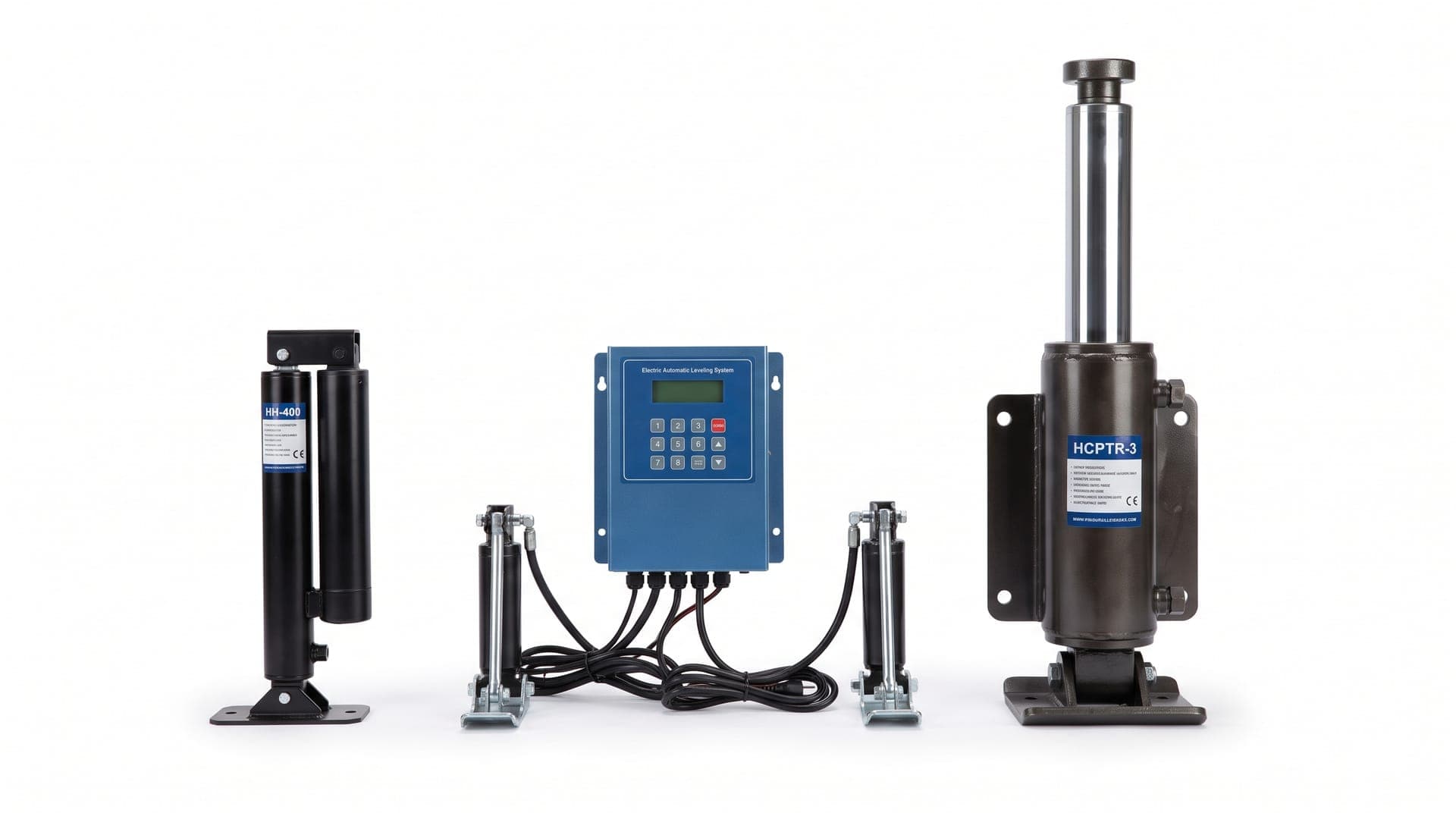
Henghong's product range covers both stabilizer and leveling system categories, with products specified for different platform weight classes and integration requirements.
Stabilizer Products
HH-400 Electric Stabilizer — DC12V, 504mm stroke, static capacity 1,000 kg, dynamic capacity 540 kg. Industrial-grade electromechanical construction, suited for chassis retrofit, axle stabilization, and slide-out support applications. The 540 kg dynamic rating is the relevant figure for specifying against deployment load — not the static figure.
SC-Series Scissor Jacks — Manual operation, capacity range 1,134–3,402 kg (2,500–7,500 lbs), extended height 610–762mm. Mechanical stabilization for entry-level platforms or as supplementary support where electrical integration is not required.
Leveling System Products
HCPSR-6 Electric Automatic Leveling System — 12,000 kg system capacity, 10,000 kg single-leg capacity, DC12V/DC24V, 400mm stroke, one-touch LCD control panel. Electric actuator-based auto leveling suited to heavy travel trailers and fifth wheels where hydraulic plumbing is not preferred.
HCPTR-3 6T Hydraulic Leveling System — 6,000 kg system capacity, 1,500 kg per-leg capacity, DC12V, 90–180mm stroke, monoblock valve technology for synchronized leg control. Mid-size RV primary leveling, fifth wheels.
HCPTR-3 12T Hydraulic Leveling System — 12,000 kg system capacity, 3,000 kg per-leg capacity, DC12V, 450mm stroke. Class A motorhomes and commercial specialty vehicles where long stroke and high per-leg capacity are required.
HH-2000 Electric-Hydraulic System — 4,000 kg system capacity, configurable per-leg capacity of 1–10T, DC12V/DC24V, 90–180mm stroke. Flexible platform for OEMs developing multiple vehicle lines at different weight classes on a common integration architecture.
Full Comparison Table
| Product | Type | System Capacity | Per-Leg Capacity | Voltage | Best For |
|---|---|---|---|---|---|
| HH-400 | Electric Stabilizer | 1,000 kg static | 540 kg dynamic | DC12V | Travel trailer stabilization, slide-out support |
| SC-Series | Manual Stabilizer | 1,134–3,402 kg range | — | Manual | Entry-level mechanical stabilization |
| HCPSR-6 | Electric Leveling | 12,000 kg | 10,000 kg | DC12V/24V | Heavy trailers, fifth wheels |
| HCPTR-3 6T | Hydraulic Leveling | 6,000 kg | 1,500 kg | DC12V | Mid-size RVs, fifth wheels |
| HCPTR-3 12T | Hydraulic Leveling | 12,000 kg | 3,000 kg | DC12V | Class A motorhomes, commercial |
| HH-2000 | Electro-Hydraulic | 4,000 kg | 1–10T configurable | DC12V/24V | Multi-platform OEM programs |
Common Misconceptions
"Stabilizers and leveling systems are the same thing."
This is the most common source of misspecification. Both products attach to the chassis underframe and extend toward the ground, which makes them look interchangeable in a parts catalog. The functional difference — one braces, one lifts — is not visible from the outside of the product but has entirely different implications for end-user experience and vehicle performance on uneven terrain.
"A more expensive system is always the better engineering choice."
For a 2,500 kg travel trailer used primarily on improved campgrounds, a set of electric stabilizers is the correct specification. Adding a full automatic leveling system to that platform does not improve the end-user outcome in proportion to the cost — it adds BOM expense, chassis integration work, and service complexity without a meaningful functional gain. Correct specification is not the most expensive specification; it is the one that matches the system function to the platform requirement.
"You need one or the other, not both."
Leveling systems and stabilizers are not competitors for the same role — they are complementary systems addressing different aspects of parked vehicle stability. On platforms where both functions are needed (active level correction plus post-leveling rigidity), specifying only one means the other function is either unaddressed or inadequately addressed.
Conclusion
The stabilizer jack vs automatic leveling system decision comes down to four factors: vehicle weight, chassis type, functional requirement (sway reduction vs active leveling), and budget constraint.
For light travel trailers parked primarily on improved sites, electric or manual stabilizers deliver the required function at the right cost. For motorhomes, heavy fifth wheels, slide-out platforms, and commercial specialty vehicles, an automatic leveling system is the appropriate specification. For larger platforms where both active leveling and post-level rigidity are required, a hybrid configuration combining a leveling system with auxiliary stabilizers is the most complete engineering solution.
The distinction between these two product categories is not subtle once the functional definitions are clear — but it is easy to miss when sourcing from a catalog. Getting it right at the specification stage eliminates a category of field complaints that are otherwise difficult to resolve after production begins.
Not sure which configuration your platform needs?
Send us your vehicle specs — GVWR, chassis type, number of support points, and stroke requirement — and our engineering team will recommend the right configuration within 24 hours.
Need Help with Your RV Leveling System?
Our engineering team is ready to help you choose the right leveling solution for your vehicle.
Contact Engineering TeamFree OEM Sourcing Checklist
A practical 6-step checklist covering capacity calculation, certification verification, supplier qualification, and logistics planning — designed for RV OEM buyers and procurement teams.
No spam. Your information will not be shared with third parties.